Sunday, 30 March 2014

TUTORIAL TO MATHEMATICS

MATHEMATICS NOTES


NOTES FORM 1 ~ FORM 4
http://smcmaths.webs.com/form4.htm


NOTES FORM 5
http://mbsskl.edu.my/panitia_math/files/2009/02/mathematics-form-5.pdf

SPM MODULE OF MATHEMATICS

SPM 2012 TRIAL PAPER


SPM 2012 TRIAL - MELAKA PAPER 1&2

QUESTION & ANSWER
http://www.mediafire.com/?42hnifc9s6piy0y
http://www.mediafire.com/?3w6o0m276epr47v
http://www.mediafire.com/?f7fbcw65lgcg4cb

SPM 2012 TRIAL - TERENGGANU PAPER 1&2

QUESTION & ANSWER
http://www.scribd.com/doc/110303883/Trial-Mathematics-Spm-Terengganu-2012-Paper-1
http://www.mediafire.com/?xe4afuq7xvii2e8

http://www.mediafire.com/?0uxrkjrlqxeoip6

SPM 2012 TRIAL - KEDAH PAPER 1&2

QUESTION & ANSWER
http://spm.banksoalankita.com/?p=115

SPM 2012 TRIAL - NEGERI SEMBILAN PAPER 1&2

QUESTION & ANSWER
http://viewnow.myschoolchildren.com/matematik-kertas-1-2-percubaan-spm-2012-n-sembilan/

SPM 2012 TRIAL - PERAK PAPER 1&2

QUESTION 
http://viewnow.myschoolchildren.com/matematik-kertas-1-2-percubaan-spm-2012-perak/

SPM 2012 TRIAL - SELANGOR PAPER 1&2

QUESTION & ANSWER
http://viewnow.myschoolchildren.com/matematik-kertas-1-2-percubaan-spm-2012-selangor/

SPM 2012 TRIAL - PAHANG PAPER 1&2

QUESTION & ANSWER
http://www.mediafire.com/?722vge8x9gyj3se
http://www.mediafire.com/?sb3xu3scmwwmmue
http://www.scribd.com/doc/105712164/Trial-Mathematics-Spm-Pahang-2012-Answer 


SPM 2012 TRIAL - SBP PAPER 1&2

QUESTION & ANSWER
http://myschoolchildren.com/peperiksaan-percubaan-spm-2012-sbp/

SPM 2012 TRIAL - MRSM PAPER 1&2

QUESTION
http://viewnow.myschoolchildren.com/matematik-kertas-1-2-percubaan-spm-2012-mrsm/


SPM 2013 TRIAL PAPER


SPM 2013 TRAIL - PENANG PAPER 1&2

QUESTION & ANSWER
http://viewnow.myschoolchildren.com/matematik-kertas-1-2-percubaan-spm-2013-pulau-pinang/


SPM 2013 TRAIL - MRSM PAPER 1&2

QUESTION & ANSWER
http://viewnow.myschoolchildren.com/mathematics-paper-1-2-trial-spm-2013-mrsm/
http://viewnow.myschoolchildren.co/skema-matematik-kertas-1-2-percubaan-spm-2013-mrsm/


JOKES OF MATHEMATICS

Q&A

  • What do mathematicians eat on Halloween? 
  • Why do plants hate math? 
  • Why did the boy eat his math homework? 
  • Have you heard the latest statistics joke? 
  • What did the acorn say when it grew up? 
  • What do you call an empty parrot cage? 
  • How can you make time fly? 
  • Why did the math book look so sad? 


Ans : Pumpkin Pi.

Ans : Because it gives them square roots.

Ans : Because the teacher told him it was a piece of cake.

Ans : Probably.

Ans : Geometry.

Ans : Polygon.

Ans : Throw a clock out the window!

Ans : Because it had so many problems.


STATEMENTS


  • A circle is just a round straight line with a hole in the middle.
  • Decimals have a point.
  • Cakes are round but Pi are square.
  • Without geometry, life is pointless.

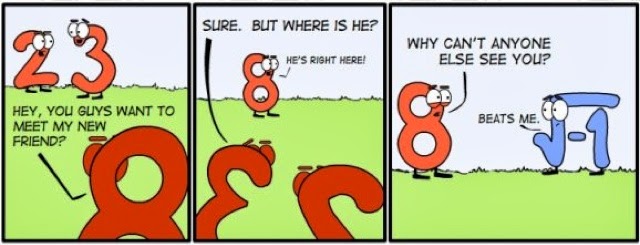
COMICS OF MATHEMATICS

FUN FUN FUN


Sunday, 23 March 2014

PROMINENT FIGURES IN MATHEMATICS

SIR ISAAC NEWTON 


Born:  25 December 1642  
Birthplace : Lincolnshire, England.
Death: 20 March 1726


Sir Isaac Newton is believed to have developed the the study of Calculus.
Newton contributed much to the field of mathematics that few will ever even understand. Some of those contributions include Newton's identities, Newton's method, and the generalized binomial theorem. He also layered the groundwork for what eventually became Euler's summation formula.

Newton is also credited with the development of many topics in, among other things, philosophy, astronomy, and physics. You may have heard of Newton's Laws of Motion, in particular his first and third laws.

First Law: an object in motion stays in motion, and an object at rest stays at rest unless and external forces acts upon it.
Second Law: The equation F = ma, where m is the mass of the object, F is the net force, and a is the acceleration.
Third Law: for every action there is an equal and opposite reaction.


ALBERT EINSTEIN

Born : 14 March 1879
Birthplace : Ulm, Württemberg, Germany
Death : 18 April 1955


Einstein was born into a Jewish family in Germany, but he spent time in Italy, Switzerland, and eventually the United States.

  He was married twice. The first time to Mileva Maric in 1903. Together they had two sons and a daughter but their marriage was ended in 1919. That same year Einstein got remarried to Elsa Löwenthal, who was actually his cousin. Elsa died in 1936. Einstein himself passed away on April 18, 1955 in Princeton, New Jersey, where he was residing at the time.

Einstein's contributions to math and science are immense, physics in particular.  Arguably, his best known achievement is : 
   
                     theory of relativity ,the famous equation E = mc2.


His research served as a foundation for what has become modern day physics. In particular, his ideas changed people's views on time, space and matter.


Pythagoras

Born : 580 - 572 BCBirthplace : Samos, GreeceDeath : 500 - 490 BC


He is said to have been born in the Greek island of Samos. That information, along with everything else about him unfortunately cannot be verified. There is no written documentation from the time that he lived.


Best known achievement :

                            Pythagorean Theorem  


Other Prominent Figures
http://www.thefamouspeople.com/mathematicians.php

Sunday, 16 March 2014

HISTORY OF MATHEMATICS

Maths' History?

People seem compelled to organize. They also have a practical need to count certain things: cattle, cornstalks, and so on. There is the need to deal with simple geometrical situations in providing shelter and dealing with land. Once some form of writing is added into the mix, mathematics cannot be far behind. It might even be said that the symbolic approach precedes and leads to the invention of writing.

Archaeologists, anthropologists, linguists and others studying early societies have found that number ideas evolve slowly. There will typically be a different word or symbol for two people, two birds, or two stones. Only slowly does the idea of 'two' become independent from the things that there are two of. Similarly, of course, for other numbers. In fact, specific numbers beyond three are unknown in some lesser developed languages. A bit of this usage hangs on in our modern English when we speak, for example, of a flock of geese, but a school of fish.

The Maya, the Chinese, the Civilization of the Indus Valley, the Egyptians, and the region of Mesopotamia between the Tigris and Euphrates rivers -- all had developed impressive bodies of mathematical knowledge by the dawn of their written histories. In each case, what we know of their mathematics comes from a combination of archaeology, the references of later writers, and their own written record.

Mathematical documents from Ancient Egypt date back to 1900 B.C. The practical need to redraw field boundaries after the annual flooding of the Nile, and the fact that there was a small leisure class with time to think, helped to create a problem oriented, practical mathematics. A base-ten numeration system was able to handle positive whole numbers and some fractions. Algebra was developed only far enough to solve linear equations and, of course, calculate the volume of a pyramid. It is thought that only special cases of The Pythagorean Theorem were known; ropes knotted in the ratio 3:4:5 may have been used to construct right angles.

What we know of the mathematics of Mesopotamia comes from cuneiform writing on clay tablets which date back as far as 2100 B.C. Sixty was the number system base -- a system that we have inherited and preserve to this day in our measurement of time and angles. Among the clay tablets are found multiplication tables, tables of reciprocals, squares and square roots. A general method for solving quadratic equations was available, and a few equations of higher degree could be handled. From what we can see today, both the Egyptians and the Mesopotamians (or Babylonians) stuck to specific practical problems; the idea of stating and proving general theorems did not seem to arise in either civilization.
Chinese mathematics -- a vast and powerful body of knowledge --, although mainly practical and problem oriented, did contain general statements and proofs. A method similar to Gaussian Reduction with back-substitution for solving systems of linear equations was known two thousand years earlier in China than in the West. The value of p was known to seven decimal places by 500 A.D., far in advance of the West.
In India mathematics was also mainly practical. Methods of solving equations were largely centered around problems in astronomy. Negative and irrational numbers were used. Of course, India is noted for developing the concept of zero, that was passed into Western mathematics via the Arabic tradition, and is so important as a place holder in our modern decimal number system.

The Classic Maya civilization (250 BC to 900 AD) also developed the zero and used it as a place holder in a base-twenty numeration system. Again, astronomy played a central role in their religion and motivated them to develop mathematics. It is noteworthy that the Maya calendar was more accurate than the European at the time the Spanish landed in The Yukatan Peninsula.

Ancient Greece?

The axiomatic method came into full force in Ancient Greek times; it has characterized mathematics ever since. Geometry was center stage in ancient times. Mathematical models, or idealizations of the real world, were built around points, lines, and planes. Numbers were represented as lengths of line segments. Modern mathematics still relies on the axiomatic method, but tends to be more algebraically based.

Key to the axiomatic method are abstraction and proof. For example, the idea of a point as a pure location with no extension is an abstraction since a point cannot physically exist. A dot differs from a point in that a dot has extension, and represents only an approximate location. Nevertheless, since they can be seen, we use dots to represent points which cannot be seen. Lines, planes and circles are also abstract ideas. That is, they represent idealizations, rather than concrete objects which actually exist. After all, a plane has no thickness, and cannot be anything except a boundary between two regions in space.
An interest in investigating the properties of abstract objects characterizes Greek mathematics. Precise definitions; a small number of commonly accepted assumptions called axioms or postulates are made; then general results (lemmas, theorems, and corollaries) are proved using logic.

One of the best ways to learn more about the history of mathematics is by looking into the lives and work of mathematicians. What follows is a brief list of mathematicians. You can read about each by clicking on the hyperlinks. Use the back button on your browser to get back here.


The Middle Ages?


In 476 A.D. The Roman Empire came to an end in the West; the last author of mathematical textbooks, Boethius, was executed in 524; the Eastern Roman Emperor, Justinian, closed the academies in Athens in 529 -- The Middle Ages had been born -- Mathematics, along with the rest of scholarly life, would fall into a decline which would last 1000 years.

Fortunately, during this period Chinese mathematics, the mathematics of India and The Arabic World would continue to flourish. Our modern base-ten number system featuring zero as a place holder was developed in the Eighth Century in India. The basis for algebra was developed in The Arabic World in the Eighth and Ninth Centuries. In fact, the word algebra comes from the Arabic al-jabr which refers to transposing a quantity from one side of an equation to the other.

One of the few bright spots in European mathematics during this period was the work of Fibonacci (1175-1250 A.D). He was the son of an Italian merchant who traveled widely and studied under a Muslim teacher. He helped to open Europe to the Arabic mathematical methods, including the use of 'Arabic Numerals,' which actually were invented in India, as we have seen. Many cegep students will have studied the Fibonacci sequence which has broad use in far-flung areas of mathematics.

By about 1500 A.D. the intellectual climate of Europe was changing. The Middle Ages were coming to an end and the Modern World was being born. Each century from that time until the present day would see the creation of powerful, new, mathematics.

The Sixteenth Century?

The 1500's saw the emergence of what we recognize as mathematics in the modern world as opposed to the geometrical discussions of ancient times. Negative numbers were slowly gaining acceptance; the + and - signs made their debut; in accounting, Arabic numerals and double-entry book keeping came into use. Many people contributed to the more symbolic, algebraically based, mathematics that was coming into being.
Girolamo Cardano published his Ars Magne in 1545. In this work he presented for the first time a general solution of the cubic equation, and some special cases of the quartic, or fourth-degree polynomial, equation. This sparked a great deal of enthusiasm and the impetus lasted for centuries as mathematicians tried to solve fifth, and higher, degree equations in a general way. Only in the 1820's did Galois and Abel show that a general solution of fifth and higher degree equations was not possible. In the mean time a great deal of fresh mathematics was spun off as a by-product of the quest. Cardano, himself, lead an outrageous life full enough for several good biographies.
François Viète developed the first system of symbolic algebra. He introduced the use of braces and parentheses, and used the + and - signs along with a number of abbreviations for other operations. He was the first to make the crucial distinction between variable quantities and constant unknowns. In his work is found most of the methods of ordinary algebra as we know it today. He even foresaw the invention of logarithms in the next century by using the trig identity 

sin a + sin b = 2 sin(a+b)/2 cos(a-b)/2

to use an addition to carry out a multiplication.

The Seventeenth Century?


The 1600's were an especially high point in scientific and mathematical history. This is the century of Kepler, Galileo, Descartes, Newton, and Leibniz . But, one of the most exciting advancements of the time was the introduction of Logarithms in 1614 by John Napier. Logarithms greatly reduced the labour involved in calculations, and was welcomed by a wider public than most mathematical ideas.

However, the two big new ideas are Descartes' founding of analytic geometry, or geometry based on algebra, and the simultaneous but independent invention of calculus by Newton and Leibniz. This is also the time when Fermat proposed his famous "Last Theorem" which has only just been proved by Andrew Wiles in the 1990's. As with the quest to find a general solution for the fifth degree (quintic) polynomial equation, the challenge presented by Fermat occupied great minds over a period of centuries and produced enormously rich benefits, but no solution until recently. Fermat's main contribution to mathematics was, however, the founding of number theory -- that branch of mathematics which deals with the arithmetic properties of the natural numbers.
Blaise Pascal worked closely with Fermat on number theory and also founded probability as we now know it. His name is commemorated in Pascal's Triangle as well as the Pascal programming language. In England, John Wallis, developed the analytic approach to the conic sections, an area dear to the hearts of many students even today. The Binomial Theorem, another favourite which dates to this period, was introduced by Newton himself. The Seventeenth Century, along with the works of Ancient Greece, establish the roots of the mathematical tradition which lives to the present day.


The Eighteenth Century?


With calculus at its center, an ever widening body of knowledge began to take shape. The frontiers of mathematics in the Eighteenth Century included differential equations, infinite series, the study of planetary orbits, the theory of numbers, solutions to algebraic equations, probability theory, and complex numbers. It is possible here only to mention a few of the key figures involved.

Joseph Louis Lagrange (1736-1813) may have been France's greatest mathematician of the century. Like several of the top mathematicians of the era he was appointed to the Berlin Academy as Court Mathematician to Frederic the Great. A shy and quiet man, he extended greatly our understanding of solutions to algebraic equations, and of planetary orbits. Another great French mathematician was Pierre Simon de Laplace (1749-1827.) A more outgoing and practical person than Lagrange, his greatest contribution may have been in the area of probability theory. Laplace treated mathematics as a tool, as a means to an end; whereas Lagrange considered mathematics as a thing of great beauty -- like poetry -- and created mathematics as an end in itself. Another important figure wasD'Alembert (1717-1783), who did significant work in differential equations, sequences and series, mechanics, and astronomy; he was a member of the FrenchAcademie des Sciences.
At some point mention should be made of the Bernoulli's. This Swiss family produced at least thirteen mathematicians over a period of two centuries. In the Eighteenth Century two brothers, Jacob and Johann, played a major role. Another Bernoulli, Jean, tutored Leonard Euler (1707-1783) who was to become, without doubt, the century's greatest mathematician. Euler divided his career between the court of Frederic the Great, at Berlin, and the Russian Academy, at Saint Petersberg. His personal life was quiet and apparently happy despite much hardship, including blindness in old age. Amazingly, he was able to continue doing original mathematics even after the loss of his eyesight by dictating his work to others. Euler's output was truly amazing; his collected works fill 74 volumes. And, he frequently held back his results so that others could claim some credit. Besides developing the use of complex numbers and founding what we now know as topology, he introduced many of today's familiar notations, including p, S, e, log x, sin x, cos x, f(x) for functions, and others.


The Nineteenth Century?


By the 1820's Augustin-Louis Cauchy (1789-1857) could state a formal definition for the limit equivalent to the modern d, e-definition; this advancement soothed centuries of haggling over the true meaning of differentials. Modern abstract algebra was getting started with the invention of group theory by Evariste Galois(1811-1832) and Niels Abel (1802-1829). Galois and Abel gave us some of the most beautiful mathematics ever written, but both men lead tragic lives -- Galois was killed in a senseless duel at age 22, and Abel died of disease and starvation brought on by extreme poverty at age 27.
Karl Frederic Gauss (1777-1854) was the greatest mathematician of the nineteenth century, and one of the greatest of all times. Despite having been born into a working-class family with a father who did not value education, he got his doctorate proving in his thesis The Fundamental Theorem of Algebra which states that an nth-degree polynomial has n roots in complex numbers.

Apart from extending calculus to the complex numbers and developing more abstract algebras, mathematics branched out in various ways. Non-Euclidean geometry is the study of geometries which result from modifications of Euclid's axioms. Along with Reimann, the names of Lobachevsky and Bolyai are impotortant here. George Boole and Georg Cantor were key in the foundations of set theory and mathematical logic. Karl Pearson (1857-1936) founded statistics as we know it today.


The Twentieth Century?


By the beginning of The Twentieth Century mathematics had grown wide and deep, so vast that it is impossible to summarize the subject here. Let us just mention one thread.
The invention of mathematical logic lead to a deep analysis of the fundamentals underlying mathematics. It seemed that in the background there was a desire to mechanize intelligent thought itself. All of this was, of course, closely related to the impending introduction of computers. Then, in 1931, Kurt Gödel proved that statements can be formed that are neither provable nor disprovable in any complete and consistent axiom set. It follows that within a given mathematical system it is not possible to prove or disprove all of the statements that can be formed. Essentially, what Gödel did was to confirm that the human mind, and its spark of insight, can never be replaced by mechanical processes.

Friday, 7 March 2014

INTRO TO MATHEMATICS

What is Mathematics?

Mathematics reveals hidden patterns that help us understand the world around us. Now much more than arithmetic and geometry, mathematics today is a diverse discipline that deals with data, measurements, and observations from science with inference, deduction, and proof and with mathematical models of natural phenomena of human behavior and of social systems. Mathematics can also be defined as the abstract study of topics such as quantity (numbers), structure, space and change.


Mathematics is used throughout the world as an essential tool in many fields, including natural science, engineering, medicine, finance and the social sciences. Mathematicians also engage in pure mathematics, or mathematics for its own sake, without having any application in mind. There is no clear line separating pure and applied mathematics, and practical applications for what began as pure mathematics are often discovered.